 Written by Mark Bailey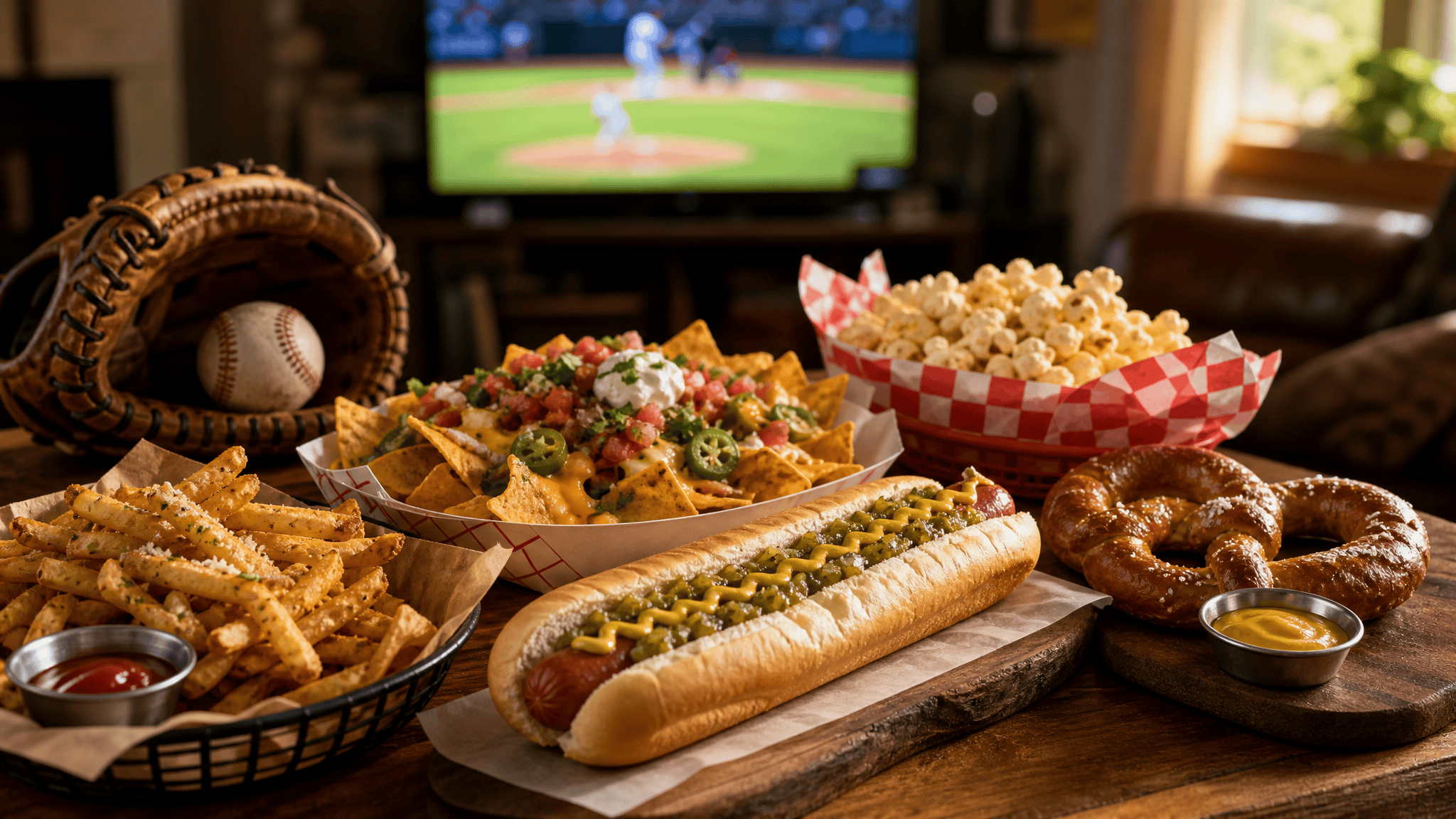
A single hot dog at the average MLB park now runs about $5.50, and if you tally up four tickets, parking, a couple of beers, two sodas, and four dogs for a family of four, you’re looking at roughly $225.90 for the afternoon. At Dodger Stadium that same basket climbs past $413.
None of that is the food’s fault. The food is the best part. The problem is the line, the price, and the fact that your kid decides he wants nachos the exact moment you sit down with the pretzels.
So here’s the fix: make it at home. A watch party in the living room, a post-game spread after Little League, a Saturday where nobody has to find parking. Below are 15 ballpark classics you can pull off in your own kitchen, most of them cheaper and easier than you’d guess, and every one of them with a little stadium history to drop while you cook.
1. The Ballpark Hot Dog
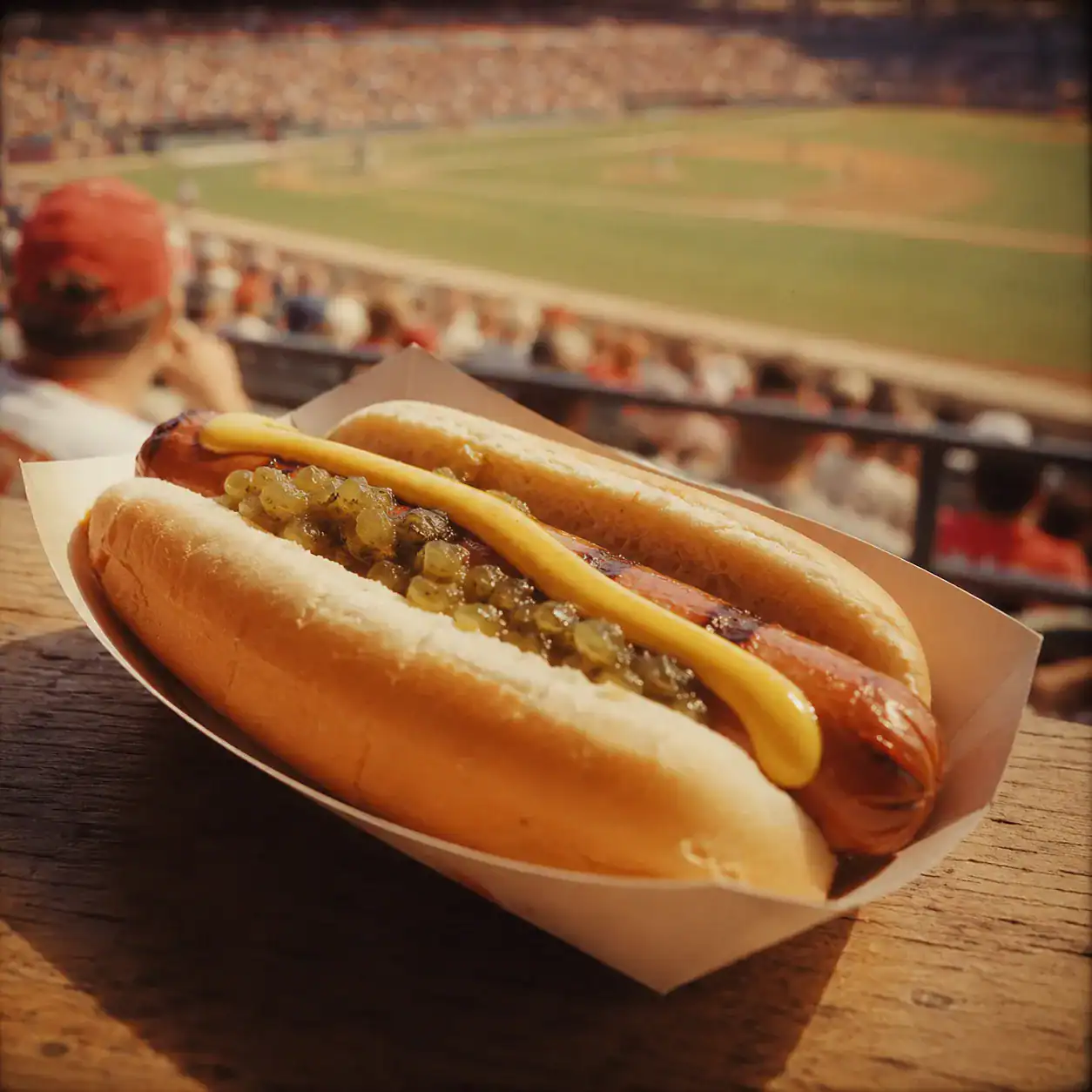
Hot dogs were one of the very first foods sold at ballgames. Legend hands the credit to the St. Louis Browns back in 1893, and the dog has never really left.
The fun part is the regional styles. A Dodger Dog is a foot-long pork dog, grilled or steamed, dressed simple with mustard and relish. They sell around 2.7 million a year, more than double the runner-up. A Fenway Frank goes in a New England split-top bun, the kind that’s flat on the sides so it toasts like bread.
A Chicago Dog is the loud one: yellow mustard, neon-green relish, onion, sport peppers, a tomato wedge, celery salt, poppy-seed bun, and absolutely no ketchup. Ask a Chicagoan about ketchup only if you want a speech.
At home you don’t have to pick. Grill or steam the dogs, put out the toppings in little bowls, and let the kids build their own. A regional dog “bar” turns dinner into an activity, and the poppy-seed and split-top buns are both right there at the store.
2. Stadium Nachos

Here’s a fact that surprises people: nachos are younger than your parents. The stadium version was invented in 1976 at Arlington Stadium by a concessionaire named Frank Liberto, who ladled warm cheese sauce over chips with a few jalapeños because it could be served in under a minute. That first season, nachos outsold popcorn about six to one.
The cheese is the whole thing, and you don’t need the pump-bottle stuff. Melt a simple sauce from butter, flour, and milk, then stir in cheddar or American until it’s smooth. Four ingredients, a few minutes on the stove, and it pours just like the real deal over a tray of chips.
Set it up as a build-your-own and the picky eaters can skip the jalapeños without a negotiation.
3. Soft Pretzels

The secret to that shiny, chewy, deep-brown crust isn’t the oven. It’s a quick dip.
You make a basic yeast dough (flour, water, yeast, a little sugar and salt), let it rise about an hour, roll it into ropes, and twist. Before it bakes, each pretzel takes a 30-second swim in boiling water with baking soda stirred in. That bath is what gives you the pretzel color and the pull. Then 13 to 15 minutes in a hot oven and a shower of coarse salt.
They keep two days in a sealed bag, though in my experience they never make it to day two.
4. Garlic Fries

If you’ve had these at Oracle Park in San Francisco, you know they nearly knock you over. That’s on purpose. The Giants play up the state’s garlic pride, since nearby Gilroy calls itself the Garlic Capital of the World and throws a whole festival for it.
The home trick is timing. Bake or air-fry your thick-cut fries first, then toss them the second they come out with minced fresh garlic, chopped parsley, and a little oil. Add the garlic raw and hot, never in the oven, or it turns bitter and burnt.
Ten minutes of hands-on work, and your kitchen smells like a ballgame.
5. Cracker Jack

“Buy me some peanuts and Cracker Jack” has been in the seventh-inning stretch since 1908, which is funny for two reasons. One, the exact recipe has been a guarded company secret for over a century. Two, neither man who wrote “Take Me Out to the Ball Game” had ever actually been to a baseball game.
You can’t make the real thing, so don’t let anyone tell you a home batch is identical. What you can make is excellent caramel corn: pop your corn, coat it in a caramel of butter, brown sugar, and corn syrup, add a pinch of baking soda so it turns light and crisp, and fold in roasted peanuts.
One heads-up for the crowd cooking with peanuts. This one and the next carry a nut allergy flag, so check before you pass the bowl around a dugout full of kids.
6. Peanuts in the Shell

The other half of the song, and maybe the cheapest snack in the whole park. Half the fun is the mess: crack, toss the shell, repeat.
At home you’ve got two roads. Buy raw in-shell peanuts and roast them in the oven with salt for a warm, classic crunch. Or go Southern and boil them, in the shell, for a few hours in heavily salted water until they’re soft and briny. Boiled peanuts split a room right down the middle, and that’s part of the charm.
Same allergy note applies here, obviously.
7. Kettle Corn

Before nachos showed up and stole the crown in 1976, popcorn was the king of the concession stand. Cheapest snack, biggest seller, been there since the beginning.
Kettle corn is the sweet-salty version and it’s genuinely easy. Oil, kernels, sugar, and salt go in a covered pot, and then you shake it, constantly, over the heat until the popping slows down. The shaking keeps the sugar from scorching, so hand that job to a kid who needs something to do.
Making it yourself means you set the sweet-to-salt ratio instead of the bag deciding for you.
8. Corn Dogs

Nobody actually agrees on who invented the corn dog, and that’s the honest answer. The Fletcher brothers claim they debuted “Corny Dogs” at the 1942 State Fair of Texas. Oregon’s Pronto Pup says its corn-battered dog on a stick was selling by 1941. The Cozy Dog Drive-In in Springfield, Illinois, calls itself the original and points to 1946.
There’s even a 1929 patent floating around that predates all three. Pick your favorite story, because the food is a winner no matter who’s telling it.
The batter is cornmeal, flour, buttermilk, egg, and baking powder, whisked thick enough to cling. Skewer the dogs, dip, and fry until golden. Kids love the dip-and-skewer part, and if you’d rather not run a fryer with a full kitchen, the air fryer handles these just fine.
9. Chili Cheese Fries

This one has no grand origin story, and honestly it doesn’t need one. It’s a mashup of two of the most successful things a ballpark ever sold: fries and that nacho cheese sauce.
Pile chili and the cheese sauce from item #2 over a tray of baked fries. Canned chili is completely allowed here, and nobody will know. It’s the kind of plate that disappears before you’ve found a seat.
10. Philly Cheesesteak

At Citizens Bank Park in Philadelphia, the cheesesteak is basically a home-team player. Tony Luke’s runs a stand right in the ballpark, slinging ribeye steaks with Cheez Whiz to a line that never really ends.
Making one at home is easier if you cheat on the meat. Freeze a ribeye or a roast just until firm, then shave it paper-thin, or run it through a food processor. Griddle the beef with onions, melt provolone or Whiz right on top, and scoop the whole pile into a soft hoagie roll.
Whiz or provolone is the great Philadelphia argument. In this kitchen, you’re allowed to have both.
11. Chicken Tenders

Every park has them, and every parent knows why. When your kid won’t touch anything with a story behind it, the tender is the peace treaty.
The home version can actually be better than the deep-fried stand version. Soak the strips in buttermilk, coat them in panko or crushed cornflakes for real crunch, and bake or air-fry instead of frying. Same golden crust, way less grease, and you can make a big tray while the game’s on.
12. The Batting Helmet Sundae

Let’s be honest, kids remember the little plastic helmet way more than the ice cream inside it. So this one is less about the recipe and more about the moment.
Scoop soft-serve or any ice cream into a real mini batting helmet (washed first) or a helmet-shaped bowl, then go full stadium: hot fudge, whipped cream, a cherry on top. Keep the helmets after and you’ve got sundae cups for every home game the rest of the season. Turning dessert into an event is half the reason to do this at home in the first place.
13. Churros

Churros come from the Spanish and Latin American street-food tradition, and over the last decade or so they’ve quietly shown up at more and more ballparks, right next to the all-American stuff.
The dough is a choux pastry, which sounds fancy but is just butter, water, flour, and eggs cooked into a thick paste. Pipe it into hot oil, fry until crisp, and roll it in cinnamon sugar while it’s still warm. If frying with kids underfoot makes you nervous, the air fryer gives you a lower-mess version that still hits.
14. Funnel Cake

Funnel cake feels like pure fairground, but it’s old, really old. The idea traces back to medieval Europe and came to America with Pennsylvania Dutch settlers a few hundred years ago, and it’s been a fair and ballpark staple ever since.
No special gear needed. Mix a pancake-style batter, then drizzle it in a loose spiral into a skillet of hot oil so it fries into that lacy tangle. Dust it with powdered sugar the moment it comes out. The messier the drizzle, the better it looks, which makes it a great one to let a kid ruin on purpose.
15. Ballpark Lemonade

Every good spread needs the drink, and nothing says summer afternoon like a cold cup of lemonade from a stadium stand.
Fresh-squeeze it into a pitcher ahead of time so it’s ready when the first pitch is. Want the grown-up move? Fill the glass half with lemonade and half with brewed iced tea and you’ve made an Arnold Palmer. Make it by the pitcher and it carries you through all nine innings without a single trip to a concession line.
Wait, Can’t I Just Bring Food Into the Game?
Sometimes, yes. There’s no single MLB rule, so it’s park by park. Most stadiums let you bring a small soft-sided cooler and sealed snacks, and nearly all of them make room for medical and dietary needs like baby formula, insulin, or allergy-safe food. Glass, alcohol, and big hard coolers are almost always a no.
Dodger Stadium and Wrigley Field let you bring outside food. Yankee Stadium doesn’t, aside from an empty water bottle. The only real rule is to check your park’s guest guide before you pack, because the sign at the gate is not where you want to learn the policy.
The Real Win
The stadium isn’t going anywhere, and some summer night you should absolutely go, spend too much, and love every minute. But you don’t need a $413 afternoon to eat like you’re at the ballpark.
You need a pot, a batting helmet you’re willing to wash, and about $5.50 of ambition. Play ball.